I was just two months away from race day, my mileage climbing, my determination high—and then my Achilles reminded me who’s really in charge. Here’s how I decided to trade one marathon for many more years of healthy running.
The Decision I Didn’t Want to Make
I had been working hard to come back from Achilles tendinitis. I made it through a 12-mile long run, but the soreness and tightness afterward told me something wasn’t right. With the marathon looming, I had to ask myself the hard questions: Do I want to run 26.2 miles like this? What will it mean for my long-term goals?
The answer became clear: one marathon wasn’t worth risking years of running ahead.
Listening to the Warning Signs
Pain during a run can sometimes be manageable, but pain and stiffness the next day are warning signals. After my long runs, I noticed my Achilles was tighter and sorer the following morning. That was my body telling me I was pushing too hard, too soon.
My New Focus: Healing First
Instead of piling on the miles, I’ve shifted to running just three times a week, no more than two miles at a time. On other days, I walk or bike to keep moving without overloading my tendon. The difference already shows—my stiffness is decreasing, and I’m walking more easily.
Building Strength and Stability
Running less gives me more room to build the strength I need:
Heavy strength training to support tendons and muscles.
Barefoot lifting at home to strengthen my feet.
Balance and mobility work to stabilize my ankles.
Massage and mobility exercises to help my Achilles remodel and heal properly.
It’s not always as fun as just running, but I know this work will pay off when I return to full training.
The Mental Side of Rest
Cutting mileage is hard. I’m used to running for hours each week, and now I’m running just 15 minutes at a time. This week felt okay because my body clearly needed the break—but I know the mental challenge will come. My hope is that focusing on strength and recovery will give me the mindset I need to get through it.
Looking Ahead
This isn’t the end of my marathon journey—it’s just a pause. By choosing to heal now, I’m giving myself the chance to run stronger and healthier for years to come. And when I finally line up for my next marathon, I want it to be with confidence in my body, not worry over my Achilles.
I was deep into training for a spring marathon when a freezing long run led to proximal hamstring tendinopathy (PHT). I didn’t make it to the starting line. Instead, I spent months—and thousands of dollars—on physical therapy.
Eventually, I was pain-free and training again for a fall marathon. Things were looking up… until Achilles tendinitis hit.
A High Followed by a Low
I had a strong 12-mile run last Saturday. It finished fast with plenty of hills, and I felt great powering up each climb. Sunday was a rest day, but Monday I still felt a little off. I went out for an easy run—still hilly—and noticed some tightness in my right lower calf. Nothing major, or so I thought.
Later that day, I felt sharp pain in my right ankle when I touched it. I rubbed and stretched it but didn’t take it seriously. The next day I tried a short, easy run and the pain hit immediately. I stopped and walked. It still hurt.
A quick internet search and a positive “pinch test” made it clear—it was my Achilles tendon. Worse yet, the swelling was visible.
My heart sank. Not another tendon injury. Not my Achilles.
The Panic, and the Plan
Achilles injuries are notoriously tough. I’d never struggled with mine before, but I know runners who have—and how long it can take to recover. But this time, I reminded myself: I’ve been here before. I’ve learned from the PHT rehab. I know what to do—and what not to do.
Tendons don’t heal like muscles. Their limited blood supply means slow recovery. Even when they “heal,” the tissue isn’t quite the same as before. But it can regain full function.
Think of it like a scar on your skin. It still works, but it’s different.
Early Recovery: Rest, but Not Too Much
In the early phase, inflammation floods the injury site. Some inflammation is necessary—but too much can damage surrounding tissue. That’s why icing several times a day can help early on.
I took three full days off from running. I iced, ate an anti-inflammatory diet, and prioritized sleep—the body’s best repair window.
But I didn’t stay totally inactive. I did gentle walking and light calf raises, stopping at the first hint of pain. This is key: Tendons heal best with some load. Total rest can actually slow healing.
It’s a delicate balance. Too much load, and you worsen the injury. Too little, and you lose ground.
Testing the Waters
After three days, my swelling had gone down and I was pain-free on long walks. I went to a track—flat and soft—and warmed up with a half-mile walk, mobility, and gentle stretches (overstretching a healing tendon is a no-no).
Then I ran two miles.
I had slight pain at the start (2/10), but it faded quickly and didn’t return. Afterward, pain briefly spiked to 3/10 while walking but dropped to zero within a few steps. A great sign.
Tendons often react 24 hours later, so I waited. No increase in pain!
Progress and Patience
The next day I ran four miles on flat roads. I warmed up the same way and had zero pain for most of the run—just some mild discomfort (2/10) in the final mile. That’s considered acceptable for tendon rehab. It’s hard, though, to run with any pain if you’re used to running pain-free.
When I first rehabbed my PHT, I had to rewire my brain to accept running with a 3–4/10 pain level. It’s not easy, but it worked. I built up slowly, even while running through some discomfort—and eventually got back to pain-free running.
This time, I’m doing the same. I finished my run, cooled down, stretched, iced—and now I wait. Another 24-hour test. I can’t plan my week out yet. I have to take it day by day.
Final Thoughts
Tendon injuries test more than your body—they test your patience, discipline, and mindset. But they also teach you resilience, and remind you that healing is not linear.
I’ve been seeing a lot of social media posts lately claiming that running makes you gain weight or wrecks your hormones. Every time I come across one of these statements, it really gets under my skin.
I’ve been running year-round since I was about 15 years old. That’s nearly 27 years of consistent running. It’s been a steady presence in my life through all of its ups and downs, and it’s one of the most important tools I have for becoming the best version of myself.
First of all, the claim that running makes you fat is simply incorrect. By definition, an activity that burns a significant amount of energy cannot directly cause weight gain. That said, I also understand the nuance behind this idea: burning a lot of calories doesn’t always translate to fat loss or even weight loss. I learned this firsthand while breastfeeding my three children. Despite the fact that breastfeeding burns a substantial number of calories, I actually tended to gain weight during those periods.
When we look at this from an evolutionary perspective — which I often do (and which, by the way, aligns with my Christian worldview and supports my belief in intelligent design) — it makes perfect sense. It wouldn’t be beneficial for a woman who is nourishing two people to lose excessive fat and risk starving both herself and her baby during times of scarcity. In fact, research shows that even though breastfeeding burns calories, a woman’s body is designed to protect fat stores as a survival mechanism. This gave women an evolutionary advantage, and during times of famine, women survived better than men.
When women are breastfeeding an infant, we have additional mechanisms that are working to ensure survival of both. The hormone prolactin, which is responsible for milk production, also promotes appetite and can prevent the breakdown of fat. I can remember feeling hunger like I’d never felt before when I was breastfeeding my oldest. I remember stuffing energy bars in my bathroom drawers so in the middle of the night when I was up with her, I could satisfy my extreme hunger.
Additionally, low estrogen (which can suppress ovulation, because again, you’re already providing for one infant, your body wouldn’t want another pregnancy yet) can affect fat distribution and reduce metabolism. Then there’s the fact that most new moms are not getting a lot of sleep and often experience higher stress levels, increasing cortisol which also promotes fat storage, instead of breakdown. So I often gained weight the first 6 months of breastfeeding with all of my kids!
The claim that running can make you fat, is based on the fact that intense cardio is a stressful event. As such, it can increase cortisol, which encourages fat storage instead of fat breakdown, but this claim over simplifies a very complex process.
Yes, high intensity cardio exercise can temporarily increase cortisol levels. So again, we turn to evolutionary biology. The thing is that exercise is one activity that humans are highly adaptive to. And we are incredibly well suited to long distance endurance events. Think about our ancestors who had to hunt for food. They often had to run animals to exhaustion in the heat of the day. This was particularly helpful in the African savanna’s where humans would run the animals in the open sun until they would collapse from exhaustion.
What gave us these advantages? Humans can sweat, unlike most other mammals that can only pant to cool themselves. We also are not covered in thick body hair, which allows our skin to cool faster. Thinking back to the breastfeeding example, where it doesn’t make sense for a woman to lose fat storage when she’s feeding two humans, it likewise wouldn’t make evolutionary sense for humans that could run as part of supplying food to store excess body fat that would surely slow them down.
Running can temporarily increase cortisol (the stress hormone) which can free up energy to be able to perform the work. Very long running sessions or high intensity running can increase the stress on the body in the short term. It’s actually chronic high stress (from lifestyle, not enough available energy, etc) that can cause fat increases.
If someone inactive starts an exercise like running for the first time, it can increase stress levels over activities like walking. That’s why I recommend if someone is just starting out, they start with a walk/run plan that gradually lets the body adapt to the stresses of running, like a couch to 5K training plan.
Humans bodies are wired to respond effectively to the physical stresses we place on it. When high intense bouts of running are combined with proper rest and recovery, the body is able to adapt and increase our fitness, or our ability to tolerate load.
In the short term, after running, people might find the number on a scale going the opposite way they want. This is because of the adaptations your body is making to help you tolerate the load in the future.
For example, your muscles start storing more water and glycogen (energy), which can make your body weight increase. It’s important to understand that this is not fat, it’s water and available energy stores. Which is one of the reasons, if you are trying to lose excess body fat, and you start exercising, I recommend not weighing yourself often because it can psychologically be defeating to see the scale going up.
Here’s what can happen to your body that can positively impact your body composition from regular running:
• Improved insulin sensitivity (reduced insulin sensitivity is one of the biggest causes of fat gain today)
• Your body stores less fat and burns more glucose (a sugar) effectively
• Running burns calories, not just when you’re running, but also improves your resting metabolic rate (overall metabolism)
• Your body adapts to be better at using both fats and carbs for fuel
• Your body adapts to better regulate hunger hormones (again, having excess fat would not have helped our running ancestors)
• Long term aerobic activity reduces visceral fat (the deep, more harmful fat)
• Running can change your overal body composition, especially when combined with strength training to have greater muscle and lower body fat
When you’re well adapted to running, it no longer causes high cortisol spikes. For example, if I go for a short recovery run where I’m just running easy it’s not really increasing my stress. My body is adapted to exercise, so the stress load is not more than going for a light walk for someone who doesn’t exercise.
Your recovery system (the parasympathetic system) becomes stronger, so cortisol spikes return to baseline faster. This helps you handle not just exercise stress better, but ALL stress better.
So while starting an exercise like running can temporarily increase stress and even make you gain weight on the scale, long term it improves your body composition and can help you reduce your stress levels overall, leading to fat loss over time.
The next claim, that running can mess with your hormones is rooted in the same logic.
If you’re always doing high intensity or excessive cardio (like always running for an hour or more every day) it can affect your hormones negatively.
This can actually breakdown muscle and suppress immune function. It can impair the thyroid, and promote fat storage.
In women, high training loads with inadequate fat levels can cause amenorrhea or cessation of menstruation. By the time amenorrhea starts estrogen and progesterone have dropped which can lead to bone loss, mood dis regulation and decreased fertility
In men, high training loads with inadequate energy availability can reduce testosterone which likewise can reduce mood, energy and muscle mass.
The body actually slows down metabolism when energy requirements are not consistently met to conserve energy making you feel tired, cold intolerant and can make you gain weight.
I believe this is where the claims about running making you fat and disrupting your hormones comes from. Often these claims encourage walking and weight training over running.
There is nothing wrong with walking or weight training as effective exercises to reduce body fat and improve overall health and body composition. Not everyone likes running and individual body differences can make the stress of running harder to tolerate. I’m certainly not suggesting that everyone should run or that it’s superior to other forms of exercise that other individuals enjoy more. The best exercise for an individual is going to be one they enjoy and will continue to do regularly.
Unfortunately, for many athletes in their younger years, running was given as a punishment and so people naturally associate running as hard and even painful (no pain, no gain) instead of a relaxing activity. I’ve heard someone say that running doesn’t count unless they’re sweating profusely and miserable. I don’t know about you, but that doesn’t sound like something I’d like to do very often.
You can see that the claims running makes you fat or disrupts your hormones are disingenuous.
Starting running slowly and ensuring proper rest and recovery as well as adequate nutrition can absolutely improve your overall health and body composition without sacrificing your hormone health.
Regular Running, especially compared to other lower intensity activities can benefit an individual by:
-reduces the risk of hypertension (high blood pressure)
-improved VO2max (maximum oxygen uptake) associated with longevity and running improves this significantly more than walking
-Increased bone density (the force of running on the bones causes them to adapt by increasing density)
-Stronger muscles especially in the lower body, which has the largest muscle groups
-Increased tendons and ligament strength
-Better joint health (which is also another false claim I see a lot of, that running bad for your joints, especially knees) running actually improves cartilage
-Muscles become more efficient at using glucose (reduced insulin sensitivity)
-better fat metabolism
-Immune system improvements (regular running increases immune surveillance)
-Improved stress resistance
-Improved resting metabolism
-Improved balance and proprioception.
-Enhanced brain function (promotes growth of new brain cells)
-Better sleep
-You burn more calories per minute running than by walking or weight training so if you’re short on time, running is an efficient way to burn a lot calories
-Running improves mitochondrial function in your cells
-Can increase your lifespan and reduce your cancer risk
-When done correctly without overtraining can help women balance estrogen and progesterone
Psychological Benefits:
-Improved mood
-serotonin and dopamine is boosted
-Improved memory
-Promotes growth of new brain cells
-Creates feelings of accomplishment and can boost resilience
Running can be a very mentally challenging form of exercise. I do love running and the many benefits I derive from it, but not every run is an enjoyable experience and some days I absolutely dread doing it. These are typically days where it’s freezing or there’s tons of snow or it seems like no matter which direction you’re running in, the wind is in your face! Sometimes when it’s a downpour and it’s already cold outside I sit there trying to talk myself into just getting out there.
The thing is, when I do, I always feel so much better and I find I feel even more accomplished the harder the conditions were. I heard it said that when you show up for yourself when it’s tough, you’re building trust within yourself. When life throw’s unexpected curve balls (and it does) you can look back on these difficult things that you got through and have confidence in yourself.
Sometimes with my kids who are too young to have built a ton of resilience yet will get so defeated at the first sign of difficulty. It’s a skill you need to practice, and running truly drives this lesson home.
Our society has become increasingly more comfortable. Yet it has not made us any happier and in fact, the mental health crises continues to just get worse. Running can be hard and uncomfortable, but for humans, who have been highly adaptable to uncomfortable environments for all our history, perhaps regularly making yourself uncomfortable can help you appreciate the things we often take for granted. I know for me, grinding out a long run in the bitter cold of winter makes me appreciate a hot showers and a warm cup of coffee so much more. And a run in the pouring rain can actually be fun once you get over the fact that you’re going to get wet.
I don’t remember many of my runs in college in detail, they mostly all just blur together but I do remember some of the harder runs in terrible weather that I made it through with my friends and teammates. My friend has a photo of us still in her home after a long run where the snow was coming down in our faces so hard that our eyebrows and eyelashes were completely covered by chunks of ice! We could barely even see, but we did it!
It know running isn’t for everyone, but I don’t want people to not do it because of poor information circulating on social media. If you enjoy it and want to do it, it absolutely can help you reach your health goals. You do need to be careful not to do too much too soon, or to overtrain without enough fuel. These mistakes CAN absolutely derail your plans. We adapt to progressively higher loads, so you should always build up mileage or training load slowly, a good rule is no more than 10% increases week over week.
My husband and I got WHOOPs last year and tried them out. Our annual contracts were up for renewal earlier this month, and we decided not to renew them mostly due to the high cost and figured we already learned quite a bit from them. Coincidentally, my Garmin watch that I’ve been running with for maybe 7 years completely died on me last week and I had to go two full days without a watch! I upgraded to the new Garmin and it actually has many of the features of the WHOOP that we liked without the yearly fee!
The WHOOP, is a device that is worn usually on the wrist or upper arm that transmits data to an app in your phone. The data includes heart rate, respiration rate, sleep data, stress data, activities, heart rate variability, etc. Every morning it summarizes this data and gives you a recovery score. This number is supposed to show you how recovered you are from the activities from the day before. It takes sleep into account and heart rate variability to give you your recovery number.
It also gives you recommendations, like taking a rest day if you overreached the day before, etc.
Heart rate variability (HRV) can be used as an indicator of fitness, but also recovery. So a higher HRV indicates a higher level of fitness. The day after a big workout or long run, your HRV would be lower, indicating you need a recovery day. Then when you see that number go back up, it typically indicates you’re recovered. So your number alone doesn’t really mean much until you’ve had several weeks of data.
So here’s what I learned, as a female runner with a years worth of data.
The first thing you may notice right away is how alcohol affects your recovery and your HRV. I’ve heard of many people actually completely giving up alcohol after using the WHOOP. My husband is kind of one of those people. I can see why. It’s one thing to know that alcohol is going to negatively impact your health when used in excess. It’s another thing to visibly see it’s effects in real time.
I’m not a big drinker to begin with. I consider myself a social drinker and I typically don’t have more than one or two drinks on days when I am drinking, which is typically only socially. Still, I definitely saw a much lower HRV, regardless of the activity I did the day before with even just one drink the day before. The absolute lowest recovery score I ever received was the day after my friend’s birthday, when I had probably had a little more than a couple drinks. My recovery was a big fat zero and even had a picture of a skull! It made me laugh, but also it was true that I wasn’t feeling so great. What I used to be able to handle in my 20’s completely kills me in my 40’s. Good thing I don’t make nights like that a regular occurrence.
What was surprising to me, was how much my monthly cycle had an effect on my HRV and therefore my recovery score. It caused me to actually do some research on how female hormones affect the body systems and I really uncovered something interesting.
For a long time, women were not represented in studies because our cycles completely threw off the results (imagine that). Now, for most research grants to be approved, the researchers must include women, unless it’s something that really doesn’t apply to us at all. So things are getting better, but unfortunately many of the decades worth of research into sports really only applies to men. So I’m going to break down what I learned.
The beginning of your cycle, is generally considered the first full day of your period, day 1. Day 1 is when both the female hormones estrogen and progesterone are both very low. What was crazy interesting to me was that my HRV and my recovery score were always very high on this day, and actually throughout the entirety of my period. What? Even when I had terrible sleep the previous night, even if I did a long run or a workout.
After my period ended and I started the estrogen dominance phase of my cycle where the body is preparing the eggs for ovulation, my HRV would go down but still stay higher than they would during the later half of my cycle. This is when patterns would emerge and I would see lower HRV the day after a strenuous workout and higher HRV after recovery days.
Then, about a week after ovulation, when progesterone is dominant, my HRV would suddenly drop, even after recovery days or even rest days. Only to spike up again once my period started. After noticing this pattern for months, I dove into the research.
As it turns out, the low HRV during the progesterone phase, or luteal phase is almost a sure sign that you did in fact ovulate that cycle. During this phase, you’re more likely to be dehydrated and your body is not as readily able to break down carbohydrates for fuel. Your metabolism is actually higher and you need more calories than during the rest of your cycle. And your basal body temperature is higher, which means you can over heat faster. Now how is it that I lived 41 years as a woman and am just finding this out?
So I thought back to some of the times when I had a bad workout for no reason in particular and just shrugged it off as a fluke, or even a race that I thought I was prepared for but just felt flat. Could it be, that at least some of these events happened to be during the luteal phase and I really was competing with less available resources.
Interesting to me too, was that I can recall some of the best workouts I had ever done were on the first few days of my period. What was that all about?
It’s well known that heat generally has a negative impact on running performance. As your body makes fitness gains, one of the adaptations it makes is being able to more efficiently cool yourself off. Humans and horses are able to do this by sweating. When our body starts to overheat, our blood vessels dilate, bringing to blood closer to the surface of the skin and away from our core to cool it down. We also start to sweat. The more fit you are, the more you will sweat, which can be rather embarrassing is some situations but it really is an indicator of good fitness.
This ability to cool yourself down is what allows you to keep performing at high levels. It’s why heat training in the summer can lead to faster fall races. And there’s a whole market right now for interesting ways to cool your body down to allow you to keep performing. My husband is trying one of these out currently. It’s a device that you can freeze and then use it to cool the palms of your hands during an intense workout of either lifting or running. In small studies, participants were able to take on more training loads and the gains they achieved held up over time.
So the fact that your temperature is lower during the first half of your cycle is not some minor thing. It makes a big difference. If your starting temperature is lower, it’s going to take longer to overheat. This allows you to run faster, for longer.
Your also better able to break down carbohydrates for energy and your body holds onto more water, which means your better hydrated. In practice this means you’ll be better able to crush your workouts and your races.
So does that mean that your workouts and races are doomed if they happen to fall during the later half of your cycle. Not entirely. Knowledge is powerful though. Once I learned these things, I started making changes during the later half of my cycle.
First of all, I need to hydrate much more than I do during the first part of my cycle. That’s something that’s easy enough to do. I also started to notice that I tend to pee more frequently during the later part of my cycle. So I just need to keep drinking, and often closer to the time that I’m going to run. And make sure I’m not peeing out all my electrolytes by adding some kind of electrolytes into my pre run water. (Right now I’m really liking using Nuun tablets and LMNT).
Also, I need to eat more food, and again, more food closer to the times I run. Even if that means simple sugars because they are quickest and easiest to digest.
Lastly, I need to dress lighter. If it’s hot, it’s going to be hot and there’s not much you can do clothes wise if you’re already planning on running in a light tank and shorts. But you can try to wet your face or hair before your run or try the palm cooling method on your run too. An easy way to do this is to freeze water bottles and set them along the course you plan on doing your workout at so you can grab them during any rest portions to help cool down.
Then of course, during the beginning phases of your cycle, if you’re feeling great, don’t be afraid to go for it. Set new PR’s, crush that workout. Still make sure you have adequate recovery periods in your plan though so you don’t get injured.
I hope you can find this useful. The other strange insight I found was that when I’m sick, my HRV and recovery score go through the roof. It’s odd because I feel like crap, but my HRV is telling me I’m set to take on new fitness challenges! Ha! I don’t recommend that. I did try to dig in to understand this trend and found LOTS of other people on the internet experiencing this strange phenomenon but the only real explanation I could find for it was parasympathetic overshoot. Basically the part of the nervous system that is trying to get you healthy again goes overboard.
It’s definitely interesting and fun to look at the data but I don’t think I need to pay for it all the time now that I’ve learned so much. Have you tried tech devices like WHOOP or something similar for your fitness? What was your experience?
Yesterday I was stressed out. Like so many of us this time of year, our schedules are packed, there’s class Christmas parties and spirit week and teacher gifts and don’t forget the bus drivers, the mail person, etc. So when I could feel the tension in my voice as I snapped at my kids, I said, “I think I need to go for my run now.”
It might seem counterintuitive to take time to go for a run when your “to-do” list is a mile long, but I’ve learned it’s necessary.
After my half marathon I took a planned week long break from running. I’ve also learned that this is crucial to help prevent unplanned breaks. Anyway, I had high hopes, figuring I’d get so much done if I didn’t spend all that time running. As with most things, reality and our expectations often don’t line up. And two days in I realized I needed to at least get out for a 30 minute walk.
So yesterday when I started getting ready for my run, my 10 year old daughter asked if she could come with me. I was ecstatic. I had been hoping she might want to, but I didn’t want to ask her because I don’t ever want to put pressure on her. I want it to be what she wants. This is something I worry about because when I grew up, I felt that pressure, to perform, to be the athlete, to make the family proud.
The great thing about running with your kids is it gives you an opportunity to talk without the distractions of home and siblings that often make deep, meaningful conversations hard.
And the topic of addiction came up naturally. I wasn’t planning on it, and often when these things come up we’re not planning on them and so we don’t have time to prepare beforehand about what we need to say. That’s ok though because I think it’s more natural when it happens organically.
When I was a kid, I was aware that my dad had an addiction to alcohol. He had always explained it as a disease he had called addiction. That his brain was wired differently, and one sip of alcohol was all it took for him to not be able to stop.
As I’ve grown, I’ve challenged his view, and it’s definitely not settled science by any means. I no longer think of addiction as a disease myself, that doesn’t mean that others can’t have their own views, but I just found this view to be too narrow and also problematic. For one thing, I had heard there was an alcoholic gene and, fearing that I myself might possess it because of my dad, I was absolutely terrified to ever have my first drink. Not saying that was a bad thing for me personally, but I don’t want my kids to think it’s this black or white thing, they either inherited this “gene” or they didn’t. It’s not that simple.
So I explained this to my daughter, who struggles with anxiety. “You know your anxiety? How sometimes you just have this feeling of unease and these thoughts that you can’t make go away, that make you feel kind of bad inside?”
She knew exactly what I was talking about.
“Well, alcohol can make all those negative feelings go away, temporarily. And it can be a huge relief for people. To get a break from that feeling. But the thing is, it’s only temporary. As soon as the alcohol wears off, all those feelings come right back, and sometimes even stronger than they were before. And oftentimes, the person did some things they’re not proud of, so then they often have problems that grow bigger and bigger. So then they don’t want to deal with it, so they just get drunk again. And the cycle repeats over and over again, and their life just keeps spiraling out of control.”
I want to be honest with my kids about addiction. Explain to them why people like it. I think that helps to understand why people get addicted. Because someday my kids are going to drink. And I want them to know it will feel good, so they are prepared for that.
I don’t think addiction is a disease like my dad does. I think sometimes the underlying anxiety or depression can have a genetic link. And I know my oldest daughter has that anxiety. I know it because I have it too. I think people with these tendencies tend to be the same people who end up addicted. I explained to her that the alcohol is like putting a bandaid on an open wound. It may hide it, but it’s not really doing anything to fix the problem.
My dad was never able to cope with stress. Even small stresses. He always felt like the world was against him. I want to be open and honest with my kids about what I think addiction really is. And that anyone can fall prey into it given the right set of circumstances. I remember feeling such relief after my first experience with alcohol realizing I must not have the alcoholic gene. This too, can be problematic thinking.
As an adult, I know stress is a constant in life. It happens to everyone. I also know that when I am stressed, I have to have tools in my toolbox to deal with it without drinking.
I don’t have time in my schedule to run as much as I do. I MAKE time in my schedule to run. Sometimes I feel guilty about it. I see other moms that seem to have it all together-and realize that I could probably have one of those completely clean, organized homes if I didn’t run so much. The thing I’ve learned though is that when I spend so much time and effort cleaning and organizing, within a few days (if even that long) it’s like I didn’t do anything. At least spending my time running, I’m coming back a more happy, patient mom and I’m doing something for my health that isn’t so easily undone.
As a good friend (who’s kids are now young adults) reminded me recently, I’ll have time later to get these things done, but I’ll never get this time back with my kids.
My kids see me reaching into this toolbox when I’m stressed out, going for a run, coming back ready to tackle the day with more patience and grace.
I listened to my daughter’s questions and answered them honestly. I want her to always know that I’m going to tell her the truth, because I want to be her source of information. If I act like these topics are too difficult, or that her questions are burdensome, she’ll stop asking. There’s no perfect way to talk to kids about these subjects, but I think being open and honest with them, and just being there, go a very long way at breaking generational patterns of avoiding, shame and fuzzy stories to try to cover for the addict.
She sees me running or walking when I feel overwhelmed and I talk about it. Now, running is not the only tool in my toolbox to deal with stress and anxiety. I’ve definitely been through situations where running was not enough. I’ve anchored my identity on my faith in God, and so that fills up the void, or the God sized hole in our hearts that we try to fill with all kinds of things (as said by an atheist). My kids have been raised with this foundation. However, I think it’s a huge misconception to think that people of faith don’t struggle still with anxiety, depression, stress, etc.
God gave us these tools. There is nothing wrong with praying and also running or going to therapy or whatever tools you have in your toolbox.
Besides running when I’m stressed, I know I need to often log off of social media, not watch the news that’s specifically made to create fear to get us to keep tuning in. I know I need to avoid certain types of people when I’m already stressed out. I know I have certain people I can talk to. I know I need to prioritize sleep and relaxation. I know that if I’m really stressed out or going through something difficult, I need to avoid alcohol, because I always have that fear as the daughter of an addict that if I start drinking when I’m stressed or upset, that I could easily fall prey too. And I want my kids to know this. I don’t want them to be too fearful of drinking, or to feel relieved if they find themselves not immediately addicted. I want them to know that addiction can creep up on anyone if they leave the door open to it. I want to help my kids build up their toolbox and also know they can always talk to me about whatever their facing, and that we’ll face it together. That their mom is not so caught up in her own problems that theirs are too burdensome.
I haven’t had a great half marathon since I had kids nearly 11 years ago. My priorities have changed considerably since having kids but I still love racing. I still love pushing myself as hard as I can and seeing what I’m capable of. I love running, regardless of whether I have a race planned, but having a race planned keeps me through the tough days and gives me something to focus on.
I started training for this half once my youngest started preschool in mid September. I do a slower build up these days because I’ve learned from injury in the past. So I needed the full 10 weeks or so to get in shape to be able to run the time I wanted.
I had one really terrible workout early on that I think was a combination of dehydration and lack of confidence, but the rest of my hard workouts went really well. They were hard- some of them, very hard but I did them with the exception of just that one.
I did many of my long runs in the rain and I touched it out, knowing it would all be worth it. And I got in shape. And I saw what I was still capable of at 40 years old. And, I love it. I love the hard work. I love pushing myself right up to that edge of my limits of my abilities and seeing how close I can get. I love the feel of having tired muscles. I love the sweat, the sucking in air, the mentally pushing yourself to keep going when your body wants you to stop. I even did one of my hard workouts with a migraine. I somehow finished the workout without feeling bad and then about a mile into my cool down the headache and nausea hit.
So by the time you get to the start of a race, you’ve already had quite the adventure. You’ve learned some things about yourself. There were so many times during workouts my pace would suddenly slow and I learned to trust my body more than my watch. Sure enough, 30 seconds later, my watch would recalibrate and I was back on pace.
No matter what happens before that actual race on your calendar, the work you put in is never wasted. You still exercised your body and improved your health physically and also mentally.
The race started off well enough. I found myself going out too fast and having to purposefully slow down that first mile. Eventually I settled in behind this guy with red socks, yellow cap, long beard. A few times I passed him and then shortly after he passed me. We ticked off the next couple miles perfectly on pace so I decided it would be good for me to work with him. Sometimes in these races I end up alone. It’s harder that way because it’s more like a training run. The point of having a race is that there are people around you that can push you to go faster than you would go by yourself. Runners appreciate this comradery. Especially when it’s a man I’m running with because we are not really competitors.
We hit mile 3 and this woman passed us. She was the first woman now in the race. We saw the motorcycle leading the men leader coming back at us, and I saw mile marker #4 for the way back, then suddenly, the woman ahead of us turned around. There was no volunteer or even cones or marks on the sidewalk to designate that this was the turn around. So the guy I had been running with and I looked at each other confused and followed her-figuring she knew what she was doing?
I was going to try to check my watch against the 4 mile marker and see if we were still in line with the course but I somehow hit stop on my watch and didn’t realize it. I ran for a little over a mile without looking at my watch (which is an accomplishment in itself for me that I was just running based on feel for that long, but also frustrating)! When I saw the mile 6 mile marker I realized my watch had been stopped for at least a mile. I was frustrated, but just started it up again and figured I could at least see if I was still on pace-and I was.
The next couple miles I was just running with this same guy, he mentioned he thought we maybe cut off less than 200 meters at that turn based on where the miles we’re hitting but we weren’t sure. I couldn’t trust my watch-such a mess, but we had been consistently hitting pace so I just tried to focus on that.
Near mile 8 we ran into the 5K walkers. There were tons of them and they were taking up the entire path. I tried yelling out “runners!” A couple times and none of them seemed to know what to do. I think we slowed down quite a bit this mile because we were weaving in and around all these walkers for pretty much the entire mile. I was frustrated. I tried yelling a few more times and sometimes they moved over but I ended up running in the grass, on the dirt, etc. I didn’t want to look at my watch because I didn’t want my pace to mess with my head. I took my GU and then a half mile later I grabbed some water at the water station. I stopped quickly and took a couple big gulps and the guy got a little ahead of me because he didn’t stop but I quickly caught back up.
Then we saw mile 9 and Tim and the kids were there cheering for me. I shot Tim a look and he just knew something was wrong but he said at that point I was still perfectly on pace.
We went downhill under a bridge and then right away there was a sign that said 1/2 marathon with cones leading you to the left up the same bridge we had just come down the other side from. He and I kind of stopped and looked at each other and decided this was probably the way to go so we did, and shortly thereafter we saw mile marker 13 and then the finish line. We stopped. He started going back to try to get back on track but I was mad and just done with this race. I went through the finish line and immediately found officials and told them what happened.
In retrospect, I should have turned around with the guy and tried to get back on course. I ended up running into him at the finish later and he still ran on pace and finished in a time I would have been pleased with, despite all the stopping and going back. He said, “you’re super fast, I hope you know that. I ran one of my best times ever and you were helping me.” And this is why I love the running community. Most other runners know what it takes to complete something like that, not just that day, but the months of work leading up to it, and we all want each other to be successful.
I ended up running the full distance of the race afterwards and I went back on the course and saw yet another area where runners were getting confused and didn’t know where to go. And it’s super frustrating for all of them to have that experience.
So I’m disappointed with what happened, but it’s never a total waste. I still ran really hard and I think I could’ve run what I wanted to. There’s no way to know for sure because the last 4 miles of a half marathon are really where the test is, but going off of how I felt at mile 9.5 and how it felt hard but not like I was not going to make it, I think I would’ve been close to my goal.
I still had an adventure and the thing about adventures is that anything can happen. I saw the humanity in another human and that always warms my heart. Tim was so upset for me and I was thankful he brought me to this race and watched the kids and that he was so sad for me. Now I’m going to take some much needed time off of running and try to get caught up on other things and ready for Christmas. Hopefully I’m teaching my kids that life throws curve balls…constantly, but it’s still worthwhile to keep going and run the race well and help out a stranger when you can. We’re all doing our best with the circumstances in front of us.
Tonight I did something that I’ve been working on for a long time. I ran a 5K under 19 minutes. It may not seem like such a big deal, but let me give a little more backstory.
Before I had kids, I was experiencing a sort of breakthrough in my running. I was running PR’s in every distance from 5K to marathon. I was also in my 20’s and logging 65 miles a week and cross training on top of that.
Before having kids I assumed I could have it all. These kids would just fit right into our world and we could just keep doing the things we were used to doing.
I laugh at my naivety. Reality hit quickly and I was soon in the thick of parenting. I never stopped running, at least not for too long save when it became uncomfortable during pregnancy or the post partum period or for injuries. Was I running 65 miles a week and cross training on top of it? I laugh again.
Running changed for me from the moment my oldest daughter was born. It wasn’t an easy change. I had honestly been addicted to the long miles, the workouts, the races. It had even been an idol for me, I’m ashamed to admit.
Having kids took me from being on top of my little world, and put me right to the bottom. I learned what sacrificial love was and how to be a servant. It humbled me to the point I barely recognize that woman I used to be. I had little humans who needed me, depended on me. It wasn’t about me anymore.
Parenting is sacrificing so much of yourself for someone else, it’s true, and it changes you in the best ways. Still, it’s not completely giving up on all your passions and dreams. These are part of who you are, and it’s the best parts of ourselves we want to pass down to our children.
So all these years, I ran. Some seasons it was very little miles and only every other day. There were a few races in there, but not many, and none of my performances came close to what I was capable of before. But I was ok with that. I knew my life had different priorities now.
Still, in the back of my mind, I always told myself, “someday”. Someday, the kids will be older and need you less, and you can train like you’re capable of again, and you can still try to get some new PRS.
Then I turned 40 this year and really nothing much changed, it’s just a number. Then summer came and suddenly I’m starting to have some symptoms of pre-menopause and that hit me like a ton of bricks!!
Why? I feel in my heart that our family is complete. I’m enjoying some of the break from the intense physical needs that kids have those first precious years of life when they need you for EVERYTHING. I’m not breastfeeding at all hours of the night, not changing diapers or chasing around a curious toddler. When I take the kids to the pool I actually don’t need to be in the pool with them anymore—I can just sit on the side and watch them. It’s a new freedom, and it’s really nice.
No, it’s no longing in me to have another baby or even just a mourning that that time is in the waning phase. I think it’s more that waning fertility, is really just a telltale sign that you are, actually aging.
It’s not that I didn’t think I would. But honestly, the last decade of my life flew by so fast between having and breastfeeding and parenting 3 babies and toddlers, I was kind of not thinking about it. I spent the entirety of my 30’s being pregnant, breastfeeding and chasing toddlers. I feel better now than I did at 35! “Someday” felt like it was nearing for me.
My youngest started preschool a couple days a week last fall and for the first time in nearly a decade, I had 5 hours a week of kid free time! And I ran. I increased my mileage to 32-35 miles a week and started doing some hard workouts again and I LOVED it!
Then one evening when I was frustrated, I set out to do a workout and I couldn’t slow myself down and so I wanted to just see how fast I could run a 5K and I ran 18:31!! It wasn’t a PR, but it was the fastest 5K I had run in 10 years. So I started to allow myself to hope and to dream again that someday I would maybe be able to run PR’s again.
Then I signed up for a couple 5K’s and ended up not running under 19 minutes and then my knee ended up flaring up and I had to take some time off running and I was so upset with myself that in my stupid desire to chase goals, I deprived myself of something I love to do that is good for me. And I realized I love running now just for running—and I’d rather do it the rest of my life than run another PR and not be able to run again.
Running is play to me. I love the long run the most. I experience “flow” when I’m out there, which is what we use to describe a child that’s wrapped up in play for hours. They are totally immersed in it and the whole world disappears to them. That’s what running, really good running is.
But I still enjoy pushing myself. I still enjoy that feeling I get after workouts that are hard. They test you. Sometimes they break you. But you come back stronger. And isn’t that a metaphor for life?
My kids have seen me run ever since they were babies. They know it’s just something I do. They know I do it because I love it. They see me running in the snow, in the rain, in the wind. They see me fail and they see that I keep trying. I don’t talk about running much with them. I don’t have to. They see me doing it.
My oldest daughter loves running, well, mostly she loves racing when she can win. She is a little frustrated with me because I won’t let her run compete much yet. She’s only 10 and I want her to love running her whole life. That’s a gift I want to give to all of them. And she’s so results driven. If it’s not a PR, if it’s not winning, she has a really hard time. And I completely GET it. I mean, that was me! And I remember the times I wanted to give it up completely because of a string of failures and feeling like I hated it. I want her to enjoy being a kid and help her to see running as something she does, not something that gives her value.
I know my kids well, and my oldest is the perfectionist. The one who gets anxious. She’s sensitive and explosive. She can be hard on others but she’s hardest on herself. I tell her that she has value and is loved no matter what.
My middle child is self described the crazy one in our family. To this day, she’s often the most challenging one to parent. She’s sweet and loving and just needs an outlet for all her energy and I’m hoping running can be that gift to her.
My son is my baby still and has the most easy going personality of the 3 of them. He “goes on runs” because he sees his mama doing it. His face still lights up every time he sees me whether I’m picking him up from school or coming back from a run.
I love the quote, maybe the best thing you do in life is someone you raise.
In church a few years ago our minister talked about finding your life’s work. That one thing that you dedicate your life to doing. You sacrifice your time and energy and money. I realized my life’s work is raising these kids to be loving and kind, God fearing people.
To quote Taylor’s message to me on Mother’s Day this year, “Mom, you’re not perfect, but you’re a good mom.” I hope to forever live up to that good enough parent these kids need me to be.
My oldest told me the other day that one of her friends noticed that she has a real connection with me. These moments show up sometimes at the dinner table without warning. You’re in the midst of all the every day chaos and then your child tells you something that instantly melts your heart. I think about the story of Jesus’s mother Mary, where it said she stored “these things up in her heart”.
I have no regrets. Running is something I do, but it’s not where my value comes from. It’s ok if all my PR’s have already happened. The time I spent, in my 30’s, probably the decade of most vitality, was well worth the time I put in with these kids.
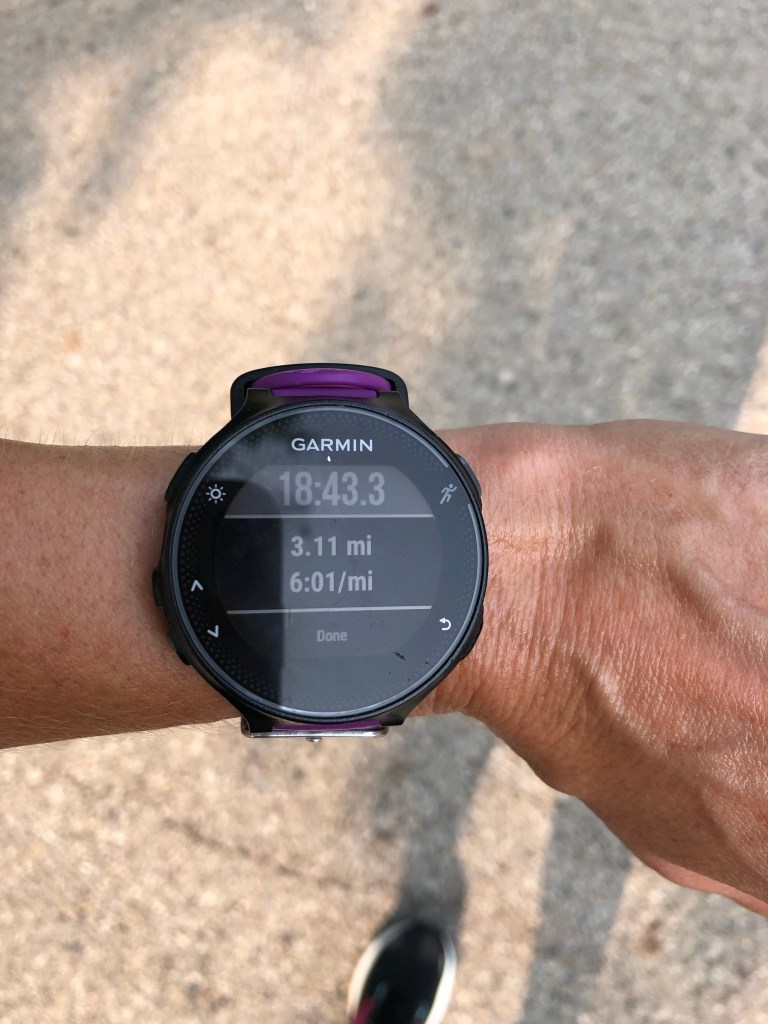
But tonight I put on my running shoes and ran a 5K in 18:43. I’ve been trying to break 19 again since that day last September when it just sort of happened.
I had a hard time slowing myself down the first couple miles—I was ready to go. It felt good to push myself HARD. It was 86 degrees but there was a nice wind when I was running west and then hot sun when I was running east. The last mile was really hard. I wanted to stop before I even got a quarter of a mile into it. That voice in my head, telling me to just stop, I could always try again another day. This wasn’t a race. Just me, a middle aged mom running through the neighborhood, chasing a dream. But I knew, I knew I had banked some time the first two miles and even if I slowed down 20 seconds in this last mile, I could still break 19 minutes. I couldn’t even look at my pace—I didn’t want to get discouraged and stop. I bargained with myself that I could stop at the half mile. That would still be a great workout. I got to the half mile and told myself to get to the next quarter—still a good workout. Then I knew I had to finish. I picked a mailbox up ahead and just ran, feeling like my feet in my shoes were 150 degrees. I looked at my watch for the distance, not the pace, and when I hit 3.1 miles I stopped and waited to see if I had run under 19 minutes. 18:43!!!!
I texted a picture of my time and sent it to my husband, then texted “I’m dead” because I felt like I was. I walked for a couple minutes, then jogged home where we cooked dinner and started our evening routine with the kids. Just another day.
Yet tonight I feel satisfied and happy that I pushed myself and didn’t stop when it got really hard. I’m again feeling hopeful that someday, someday I’ll train more and maybe, just maybe I can set some new after 40 PRs.
This week we had a couple rough start mornings followed by a rough practice with my daughter’s team I coach where my own daughter kept interrupting when I was trying to keep the girl’s attention. Then I heard from my sitter that my younger daughter had a hard time listening.
We got home, had a family meeting, enacted some consequences and had a much better morning. Then this morning happened.
I had texted my husband last night while he was coaching my daughter’s soccer practice, to get some cash out at the ATM because my oldest needed some tomorrow for school (why oh why are there SO many events in the last 2 months of school?!) and we needed it for various other things coming up, like paying our sitter for the practices I coach to watch my other kids.
Anyway, said daughter who is not supposed to be on phones or devices at all this week was using his phone to practice her songs for her music field trip coming up. So he missed my text, didn’t get cash out and this morning I had to scramble to get it together.
Then I tried sending an email to the parents of the girls I coach and it wasn’t working from my phone, I tried using my computer and it died and the charger apparently no longer is working. I was thoroughly frustrated before 7 am.
My daughter started asking me random irrelevant questions as I’m trying to get everyone out the door and I got very short with her. Then I felt terrible about it.
From talking to other moms, I know for a fact that my experience is not unique to only me. We all have date like this and they tend to make us feel like complete failures.
The truth IS that raising kids today is so much different than it’s ever been before. Some of it, we put on ourselves, for sure, but some of it, is just that our culture is so different too. Technology makes it different. I could probably write a book (if I had the time, ha!) on just how different it is raising kids now than it was when I was a kid.
My point is this. If you are a parent that is trying to raise your kids counter-culturally, it’s going to be very difficult. It’s hard to be involved with your kids and take an active role parenting them. You’re going to slip up and you’re going to mess up. Ultimately though, being involved is what’s important.
I’ve been thinking about running lately and why I love it so much. It’s not always easy to put into words but I’m trying because these girls I coach, I really want to give them the gift of running.
There are days that I am excited to run. The sun is shining and the weather is perfect. Then there are days when the wind chill is -10 and it’s a blizzard. Or the rain is just pouring down and it’s not a warm rain. On these days, I can’t exactly say that it’s easy to get out there. But when I do, when I’m gritting through the elements or fighting off a virus or dealing with sore muscles, or…or…or, any time it’s not all flowers or rainbows, THOSE are the runs that empower me.
It’s not something you can experience in a video game. The feeling of your body, being pounded by the elements and getting through it, one step at a time. The confidence you feel afterwards is invigorating.
It’s the same with faith. It’s usually when we’re in the eye of the storm that our faith blossoms the most, not during times of plenty.
So parents, if you’re struggling and feeling defeated, take heart. Gritting through these difficult times is helping you grow. Putting in the hard work now, digging in, and showing your family that you’re in it, no matter what shows them the depth of your love for them. Keep failing and learning and picking yourself back up.
As I sit here, we’re only 30 days from March first!
January has been so different this year than usual in that we had a ton of snow over Christmas but then didn’t get any more to speak of until this past week.
I kind of thought that would make winter much easier, but around the 3rd week in January, I still felt some of the feelings I usually do around that time. Tiredness, irritability, impatience, insomnia, just kind of a foul mood in general, for no good reason.
So I don’t think it’s so much the snow that makes winter so challenging. I was thankful that I didn’t have to deal with the snow for running purposes and I found myself increasing my mileage and even doing some workouts because, with clear roads, there was no reason not to.
The thing that was really difficult was the lack of sunshine. The vast majority of the days were dark and cloudy and we would go 2 weeks without the sun even peaking out of the clouds for a few minutes. Without snow, the landscape took on a dark tone with bare trees and muddy grounds. On top of that, we had several days of rain.
Several minutes of the sun peaking through on one of my hikes with my son
I signed up for this 1,000 hours outside challenge for the year and I got the kids excited to try some new things like snow tubing and cross country and downhill skiing. We couldn’t do any of that.
We did get outside some and we had some great, muddy hikes and every time during the month that the sun did peek out, I fully enjoyed it.
Now that we have snow again, it’s really brightened the landscape. Even though it’s still not really sunny out, looking at the bright landscape almost mimics the sun and I think it helps our brains to tell the difference between day and night.
It makes running more challenging but I’ve decided to embrace it this winter. Usually, I’m trying to just “get through” my running in the winter. Keep the level of fitness I’m in and then push myself again in the spring. I decided if I’m going to live in Michigan, I shouldn’t just be trying to survive in the winter, I should be enjoying the difference it brings.
I’ve been watching a YouTube vlogger, Jonna Jinton at night lately. She lives in northern Sweden where it is winter half the year! In December they don’t get any daylight, just one hour of twilight each day. She talks about her struggles with embracing winter and she’s done many things to help herself really enjoy it. It’s inspired me to try to find ways to enjoy it too.
So when we had a fresh blanket of snow on the ground last week, I decided to do something different. Usually I’m trying to find clear roads to run on, but that comes with it’s own challenges. The roads that are clear, often have the most traffic and the shoulders don’t get cleared. So every time a car comes along I need to move onto the shoulder which is usually covered in snow and slush. Now with having my dog too, it’s just extra stressful to try to make sure there’s enough room for both of us to stay out of the way of cars.
So I took my dog to a park that has lots of cross country trails. I figured, why fight the snow. I knew my times would be slower, but I didn’t have to always be such a slave to my watch. To my delight, the paved trail they had been building in October was completed!
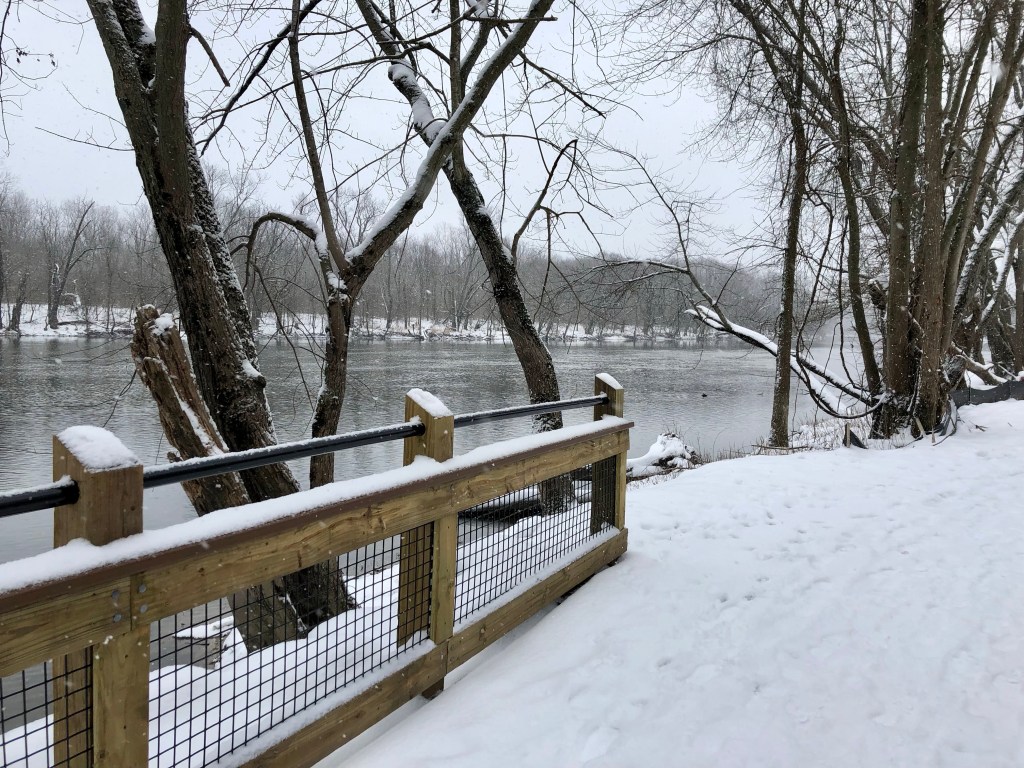
The paved trail cut through the woods. There was only a couple inches of snow on the ground and not many footprints so it was actually good traction. The woods looked beautiful covered with the bright white snow. The path meandered right next to a large black river. The contrast between the white of the snow and the darkness of the river and trees was just beautiful.
I didn’t even mind climbing up the long hill and the view from the top of the river was just breathtaking. The path now connected 3 parks and I was able to get my 6 miles in there.
I loved that experience so much that I decided to go back and run there for my long run on Saturday morning. We had a bit more snow and there had been quite a bit more foot traffic, so the footing was not as great as it was earlier in the week, but the stunning beauty of it made up for that.
The worst part of my run was actually on the busiest street as car after car drove by us and I struggled to find good footing on the shoulder.
I finished the run, and later took my girls out for a walk in the same woods I was in. The kids found even more interesting things to do like peel little bits of ice off of the wood dense and throw them into the River.
As we enter February, I’m expecting it to be cold and for there to be much more snow. I’m ok with that. Now we are excited to try to plan some of these winter activities. And of course, it’s always so nice to go back home into a warm house after being outdoors. Much like the contrast in the scenery of light snow on dark trees is calming, the contrast of warm and cold also brings comfort and appreciation for both. Sipping on a hot cup of coffee or tea as my fingers gradually warm up makes me feel happy to be alive.
Sometimes, we hope and pray so hard for something good, and it seems like the answer is no. What do we do? How do we move forward when things feel so hopeless.
“For My ways are not your ways”
“Father, if there is any other way, please take this cup…Your will be done.”
I’ve been in this place before and it’s one of the more unpleasant places. You put in all the hard work, were best suited for that promotion and it didn’t happen. You trained so hard for that race and your workouts were all showing you should be more than able to hit that goal, but race day comes and you fail miserably. Why did I even bother?
I remember going through some of the secondary infertility we experienced and feeling so hopeful going into a month that everything was done “right” only to stare in anger at yet another negative pregnancy test.
Sometimes it’s even bigger than that. Sometimes it’s in regards to laws and policies that leave you feeling completely gutted.
In all these situations, it felt like you did what you were supposed to do, but didn’t get the results. It’s hard to not feel like it’s a judgement of you personally. It’s hard to not be angry. It’s hard to not feel hopeless or wonder why you should put yourself out there emotionally ever again.
Take heart. Jesus was preaching in a corrupt Roman Empire. And word spread quickly of His teachings and His healing and He even was said to be the long awaited Messiah prophesied. People were full of hope. Hope that He, like Moses would lead the people out of oppression.
When He rode a donkey, people waved palms, fulfilling yet another prophesy. Yet He was murdered. Not only that but He was mocked and humiliated. Stripped down naked. The people who truly believed He was the Messiah must have wondered why He didn’t free Himself from the cross and end it all there. Instead, He allowed it to occur.
Can you imagine what the believers must have been feeling? I can. I can feel it. They were hopeless. It would seem that the naysayers were right all along. They were made out to be fools and conspiracy theorists. But this wasn’t the end of the story.
Jesus rose on the third day. And on the day of Pentecost was the birth of Christianity. A fire that still burns brightly today. The Bible is still the bestselling book of all time.
It’s hard not to feel dismayed, hopeless, broken or even humiliated when we think we’ve been defeated. I urge you to remember that the story is not over. Sometimes God is working something even bigger and better in our moments that feel like defeat.
Don’t give in to feeling hopeless. Sing praises and be joyful even in your suffering. The enemy wants us feeling broken and defeated. But we have a strength that they can’t take away.
Encourage each other. Get back up and joyfully do the work. Pray. Love. Rejoice in your sorrows and let the flame within you shine all the brighter. Laugh when you are mocked. Don’t allow yourself to be humiliated. Be brave like Daniel going into the flaming furnace, saying “even if God doesn’t get me out of this, He is still God!”
If you want to change the world, go home and love your family. Love your community. Love your enemy.









 Filling Up the Cup