I was deep into training for a spring marathon when a freezing long run led to proximal hamstring tendinopathy (PHT). I didn’t make it to the starting line. Instead, I spent months—and thousands of dollars—on physical therapy.
Eventually, I was pain-free and training again for a fall marathon. Things were looking up… until Achilles tendinitis hit.
A High Followed by a Low
I had a strong 12-mile run last Saturday. It finished fast with plenty of hills, and I felt great powering up each climb. Sunday was a rest day, but Monday I still felt a little off. I went out for an easy run—still hilly—and noticed some tightness in my right lower calf. Nothing major, or so I thought.
Later that day, I felt sharp pain in my right ankle when I touched it. I rubbed and stretched it but didn’t take it seriously. The next day I tried a short, easy run and the pain hit immediately. I stopped and walked. It still hurt.
A quick internet search and a positive “pinch test” made it clear—it was my Achilles tendon. Worse yet, the swelling was visible.
My heart sank. Not another tendon injury. Not my Achilles.
The Panic, and the Plan
Achilles injuries are notoriously tough. I’d never struggled with mine before, but I know runners who have—and how long it can take to recover. But this time, I reminded myself: I’ve been here before. I’ve learned from the PHT rehab. I know what to do—and what not to do.
Tendons don’t heal like muscles. Their limited blood supply means slow recovery. Even when they “heal,” the tissue isn’t quite the same as before. But it can regain full function.
Think of it like a scar on your skin. It still works, but it’s different.
Early Recovery: Rest, but Not Too Much
In the early phase, inflammation floods the injury site. Some inflammation is necessary—but too much can damage surrounding tissue. That’s why icing several times a day can help early on.
I took three full days off from running. I iced, ate an anti-inflammatory diet, and prioritized sleep—the body’s best repair window.
But I didn’t stay totally inactive. I did gentle walking and light calf raises, stopping at the first hint of pain. This is key: Tendons heal best with some load. Total rest can actually slow healing.
It’s a delicate balance. Too much load, and you worsen the injury. Too little, and you lose ground.
Testing the Waters
After three days, my swelling had gone down and I was pain-free on long walks. I went to a track—flat and soft—and warmed up with a half-mile walk, mobility, and gentle stretches (overstretching a healing tendon is a no-no).
Then I ran two miles.
I had slight pain at the start (2/10), but it faded quickly and didn’t return. Afterward, pain briefly spiked to 3/10 while walking but dropped to zero within a few steps. A great sign.
Tendons often react 24 hours later, so I waited. No increase in pain!
Progress and Patience
The next day I ran four miles on flat roads. I warmed up the same way and had zero pain for most of the run—just some mild discomfort (2/10) in the final mile. That’s considered acceptable for tendon rehab. It’s hard, though, to run with any pain if you’re used to running pain-free.
When I first rehabbed my PHT, I had to rewire my brain to accept running with a 3–4/10 pain level. It’s not easy, but it worked. I built up slowly, even while running through some discomfort—and eventually got back to pain-free running.
This time, I’m doing the same. I finished my run, cooled down, stretched, iced—and now I wait. Another 24-hour test. I can’t plan my week out yet. I have to take it day by day.
Final Thoughts
Tendon injuries test more than your body—they test your patience, discipline, and mindset. But they also teach you resilience, and remind you that healing is not linear.
Yesterday, I headed out for a long run that doubled as a VO2 max workout. I’d slept in a little, so by the time I got moving, it was hotter and more humid than I’d hoped for.
This was my second tough workout of the week, and I wanted to push myself — but not overreach. The plan was simple but demanding: a warm-up, then 8 sets of 2-minute intervals at 5K pace, each followed by a 2-minute jog recovery.
Heat, Humidity, and Hard Lessons
When the temperatures climb and the humidity makes cooling difficult, it’s easy to underestimate how quickly things can go south. I’ve been learning how to manage this better — mostly by making mistakes.
There have been plenty of workouts I’ve had to cut short, or skip entirely, because I misjudged how hard the heat would hit me.
Yesterday, the first 4 intervals went well. I was hitting my paces, but I made a smart adjustment: instead of jogging between sets 4 and 5, I walked and sipped from the 10 oz of electrolyte drink I’d brought. It wasn’t cold, but it helped.
Understanding the Body in Heat
When it’s humid, your body works overtime trying to cool you. Sweat doesn’t evaporate efficiently, so your heart rate climbs as your body pushes more blood to the skin’s surface to cool off. Even on hot days, your core temp is usually higher than the air — unless you’re running in triple-digit heat.
I have a high sweat rate. It’s actually a sign of good fitness, but it comes with a cost — I lose a lot of fluids and electrolytes, which can hurt performance.
Knowing When to Adapt
I finished the 5th interval on pace but started to feel the strain. Around 40 seconds before each rep ended, I was already digging deep. Struggling in the final 10 seconds is one thing — but 40 seconds is a lot of pain real estate.
I had two choices: slow down or adjust the recovery. Slowing would’ve been smart and effective — just a 10–15 second drop in pace still stresses the system enough. But I’ve always struggled to back off once I’m locked into a rhythm.
In college, my coach sometimes cut my workouts short because I’d push too hard on the intervals. That was before GPS watches gave you instant pace feedback.
So I compromised: I added 30 seconds to my recoveries for sets 5 through 8. That gave me the margin I needed to stay on pace without redlining.
The Cool Down and the Cemetery
After the final rep, I walked a few minutes, finished the rest of my electrolyte drink, and began my cooldown jog.
Sometimes the cooldown feels harder than the workout. That’s when I focus on slowing down, breathing well, maintaining good form — and finding something to enjoy.
As I jogged through a cemetery, I passed an elderly man walking with a cane. He was moving slowly, carefully — but he was moving. I wanted to say something encouraging, but I wasn’t sure how it would come across. So I simply smiled and said, “Good morning.”
Reflection on Movement and Mortality
As I ran past the rows of gravestones, I thought about him. About all of us. Maybe he was thinking the same thing: this is where we’re all headed. First old age, then eventually, the end.
We don’t like to think about death — not in our culture, anyway. Our ancestors lived with it more directly. Today, we’re shielded from it, which makes it harder to accept.
But the truth remains: we can’t outrun aging. We can’t outrun death.
Still, I realized — by pushing myself the way I do, I’m at least kicking the old man down the curb. Delaying the inevitable a little longer.
No one knows what their future holds. But while I have this strength, this breath, this body — I’ll keep pushing. Every effort, every hard rep, every mindful step — it’s one more act of quiet resistance.
We can’t escape our own mortality. But we can train our bodies and minds today to better face the challenges of tomorrow.
The morning of July 5th, waking up early in a campground is an experience. When my alarm went off, I wanted to close my eyes and try to get a little more sleep, but I got up instead.
Outside our camper, it was already warm—warmer than it had been the past few mornings. The campground was still and quiet. The sun lit up the remnants of the night before: toys, coolers, Fourth of July decorations scattered around every site, like snapshots of joy frozen in time. It made me smile.
But I had work to do.
Running Through Summer
I’ve never wanted to do a fall marathon because I don’t like doing the bulk of my training in the summer. I love running—but I also love summer and my family. Running all those miles often means missing out on both.
Plus, the heat has always been tough for me. I think I have a high sweat rate, and in warmer temps, I often finish my runs feeling drained, even sick. Still, I was determined to give this training cycle my best shot.
So I woke up even earlier to hydrate for my 11-miler. By the time I started running, my stomach was full of fluid—I felt it sloshing around, and I was a little nauseous. But I knew my body would thank me later.
Running with Friends Makes All the Difference
I ran the first 8 miles with one of my best friends. We’ve logged countless miles together—in high school, college, and beyond. We push each other in a good way.
There was a long hill on our way back, and if she hadn’t been there, I probably would have stopped to take a breather. Even after all that hydration, I was definitely feeling the effects of the heat.
After she finished her miles, I grabbed an electrolyte drink and guzzled 8 ounces, followed by a GU energy gel. I usually don’t take fuel unless I’m running 13+, but I’m learning that even on shorter long runs, it can help.
The last 3 miles I ran with her husband. That helped too. When I’m alone, it’s easy to get stuck in my own head and focus too much on discomfort. Having someone beside me, even just for accountability or pride, makes a difference.
Comebacks and Conviction
I finished all 11 miles. It was the longest I’ve run since January, when I was training for a spring marathon I never got to race due to proximal hamstring tendinopathy.
Was I tired? Yes. Dehydrated? For sure. But also proud. It felt good to complete a hard run and know a rest day was coming, followed by a lower-mileage week. I’ve used a “2 weeks hard, 1 week easy” structure for years—and it works for me.
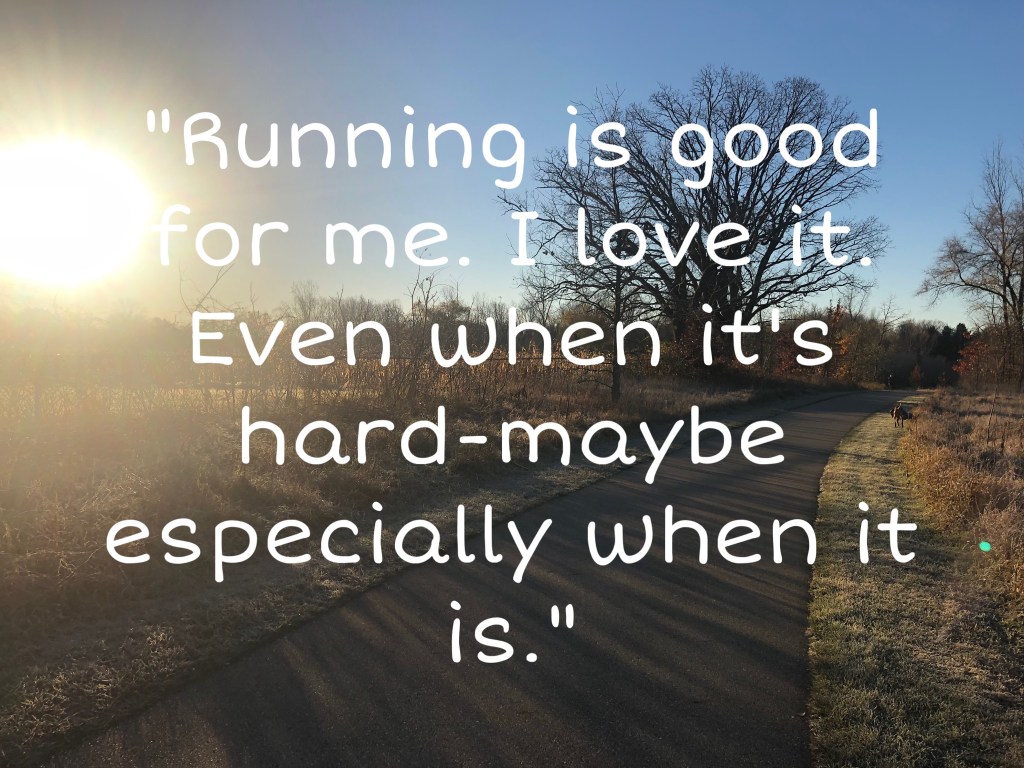
“Running is my exercise true love—and I believe my body can still do it.”
Now that I’m over 40, I’ve had a few health professionals suggest I scale back—run fewer days, cross-train more, or even (gasp) switch to walking.
I know they mean well. But in the politest of terms: I don’t think so.
I like walking. I cross-train occasionally. I stretch and strength train and fuel wisely. But running is still what I love. And my body, even after injury, still shows up for it.
Why I Still Run
Completing that 11-miler, including a few legit hills, at a pace I once ran in my 20s? That’s a victory. It felt hard—but I did it.
Yes, I’m aging. We all are. But there are plenty of runners much older than I am still doing this—and doing it well. Why not me?
I talked about this with my friend’s husband during those last 3 miles. We’re trying to actually live the rest of our lives. And for me, that includes doing what I love—even when it’s hard.
Maybe especially when it’s hard.
Later that day, I pulled out my massage gun and worked on the same hamstring I injured back in January. It felt tight but okay. I stretched. I paid attention. I took care of myself—because I want to keep doing this for a long time.
Hard Things Are Worth It
Running is hard sometimes. Parenting is hard. Life is hard. But pushing through something physically hard helps me face the other hard things with more resilience.
I’ve been seeing a lot of social media posts lately claiming that running makes you gain weight or wrecks your hormones. Every time I come across one of these statements, it really gets under my skin.
I’ve been running year-round since I was about 15 years old. That’s nearly 27 years of consistent running. It’s been a steady presence in my life through all of its ups and downs, and it’s one of the most important tools I have for becoming the best version of myself.
First of all, the claim that running makes you fat is simply incorrect. By definition, an activity that burns a significant amount of energy cannot directly cause weight gain. That said, I also understand the nuance behind this idea: burning a lot of calories doesn’t always translate to fat loss or even weight loss. I learned this firsthand while breastfeeding my three children. Despite the fact that breastfeeding burns a substantial number of calories, I actually tended to gain weight during those periods.
When we look at this from an evolutionary perspective — which I often do (and which, by the way, aligns with my Christian worldview and supports my belief in intelligent design) — it makes perfect sense. It wouldn’t be beneficial for a woman who is nourishing two people to lose excessive fat and risk starving both herself and her baby during times of scarcity. In fact, research shows that even though breastfeeding burns calories, a woman’s body is designed to protect fat stores as a survival mechanism. This gave women an evolutionary advantage, and during times of famine, women survived better than men.
When women are breastfeeding an infant, we have additional mechanisms that are working to ensure survival of both. The hormone prolactin, which is responsible for milk production, also promotes appetite and can prevent the breakdown of fat. I can remember feeling hunger like I’d never felt before when I was breastfeeding my oldest. I remember stuffing energy bars in my bathroom drawers so in the middle of the night when I was up with her, I could satisfy my extreme hunger.
Additionally, low estrogen (which can suppress ovulation, because again, you’re already providing for one infant, your body wouldn’t want another pregnancy yet) can affect fat distribution and reduce metabolism. Then there’s the fact that most new moms are not getting a lot of sleep and often experience higher stress levels, increasing cortisol which also promotes fat storage, instead of breakdown. So I often gained weight the first 6 months of breastfeeding with all of my kids!
The claim that running can make you fat, is based on the fact that intense cardio is a stressful event. As such, it can increase cortisol, which encourages fat storage instead of fat breakdown, but this claim over simplifies a very complex process.
Yes, high intensity cardio exercise can temporarily increase cortisol levels. So again, we turn to evolutionary biology. The thing is that exercise is one activity that humans are highly adaptive to. And we are incredibly well suited to long distance endurance events. Think about our ancestors who had to hunt for food. They often had to run animals to exhaustion in the heat of the day. This was particularly helpful in the African savanna’s where humans would run the animals in the open sun until they would collapse from exhaustion.
What gave us these advantages? Humans can sweat, unlike most other mammals that can only pant to cool themselves. We also are not covered in thick body hair, which allows our skin to cool faster. Thinking back to the breastfeeding example, where it doesn’t make sense for a woman to lose fat storage when she’s feeding two humans, it likewise wouldn’t make evolutionary sense for humans that could run as part of supplying food to store excess body fat that would surely slow them down.
Running can temporarily increase cortisol (the stress hormone) which can free up energy to be able to perform the work. Very long running sessions or high intensity running can increase the stress on the body in the short term. It’s actually chronic high stress (from lifestyle, not enough available energy, etc) that can cause fat increases.
If someone inactive starts an exercise like running for the first time, it can increase stress levels over activities like walking. That’s why I recommend if someone is just starting out, they start with a walk/run plan that gradually lets the body adapt to the stresses of running, like a couch to 5K training plan.
Humans bodies are wired to respond effectively to the physical stresses we place on it. When high intense bouts of running are combined with proper rest and recovery, the body is able to adapt and increase our fitness, or our ability to tolerate load.
In the short term, after running, people might find the number on a scale going the opposite way they want. This is because of the adaptations your body is making to help you tolerate the load in the future.
For example, your muscles start storing more water and glycogen (energy), which can make your body weight increase. It’s important to understand that this is not fat, it’s water and available energy stores. Which is one of the reasons, if you are trying to lose excess body fat, and you start exercising, I recommend not weighing yourself often because it can psychologically be defeating to see the scale going up.
Here’s what can happen to your body that can positively impact your body composition from regular running:
• Improved insulin sensitivity (reduced insulin sensitivity is one of the biggest causes of fat gain today)
• Your body stores less fat and burns more glucose (a sugar) effectively
• Running burns calories, not just when you’re running, but also improves your resting metabolic rate (overall metabolism)
• Your body adapts to be better at using both fats and carbs for fuel
• Your body adapts to better regulate hunger hormones (again, having excess fat would not have helped our running ancestors)
• Long term aerobic activity reduces visceral fat (the deep, more harmful fat)
• Running can change your overal body composition, especially when combined with strength training to have greater muscle and lower body fat
When you’re well adapted to running, it no longer causes high cortisol spikes. For example, if I go for a short recovery run where I’m just running easy it’s not really increasing my stress. My body is adapted to exercise, so the stress load is not more than going for a light walk for someone who doesn’t exercise.
Your recovery system (the parasympathetic system) becomes stronger, so cortisol spikes return to baseline faster. This helps you handle not just exercise stress better, but ALL stress better.
So while starting an exercise like running can temporarily increase stress and even make you gain weight on the scale, long term it improves your body composition and can help you reduce your stress levels overall, leading to fat loss over time.
The next claim, that running can mess with your hormones is rooted in the same logic.
If you’re always doing high intensity or excessive cardio (like always running for an hour or more every day) it can affect your hormones negatively.
This can actually breakdown muscle and suppress immune function. It can impair the thyroid, and promote fat storage.
In women, high training loads with inadequate fat levels can cause amenorrhea or cessation of menstruation. By the time amenorrhea starts estrogen and progesterone have dropped which can lead to bone loss, mood dis regulation and decreased fertility
In men, high training loads with inadequate energy availability can reduce testosterone which likewise can reduce mood, energy and muscle mass.
The body actually slows down metabolism when energy requirements are not consistently met to conserve energy making you feel tired, cold intolerant and can make you gain weight.
I believe this is where the claims about running making you fat and disrupting your hormones comes from. Often these claims encourage walking and weight training over running.
There is nothing wrong with walking or weight training as effective exercises to reduce body fat and improve overall health and body composition. Not everyone likes running and individual body differences can make the stress of running harder to tolerate. I’m certainly not suggesting that everyone should run or that it’s superior to other forms of exercise that other individuals enjoy more. The best exercise for an individual is going to be one they enjoy and will continue to do regularly.
Unfortunately, for many athletes in their younger years, running was given as a punishment and so people naturally associate running as hard and even painful (no pain, no gain) instead of a relaxing activity. I’ve heard someone say that running doesn’t count unless they’re sweating profusely and miserable. I don’t know about you, but that doesn’t sound like something I’d like to do very often.
You can see that the claims running makes you fat or disrupts your hormones are disingenuous.
Starting running slowly and ensuring proper rest and recovery as well as adequate nutrition can absolutely improve your overall health and body composition without sacrificing your hormone health.
Regular Running, especially compared to other lower intensity activities can benefit an individual by:
-reduces the risk of hypertension (high blood pressure)
-improved VO2max (maximum oxygen uptake) associated with longevity and running improves this significantly more than walking
-Increased bone density (the force of running on the bones causes them to adapt by increasing density)
-Stronger muscles especially in the lower body, which has the largest muscle groups
-Increased tendons and ligament strength
-Better joint health (which is also another false claim I see a lot of, that running bad for your joints, especially knees) running actually improves cartilage
-Muscles become more efficient at using glucose (reduced insulin sensitivity)
-better fat metabolism
-Immune system improvements (regular running increases immune surveillance)
-Improved stress resistance
-Improved resting metabolism
-Improved balance and proprioception.
-Enhanced brain function (promotes growth of new brain cells)
-Better sleep
-You burn more calories per minute running than by walking or weight training so if you’re short on time, running is an efficient way to burn a lot calories
-Running improves mitochondrial function in your cells
-Can increase your lifespan and reduce your cancer risk
-When done correctly without overtraining can help women balance estrogen and progesterone
Psychological Benefits:
-Improved mood
-serotonin and dopamine is boosted
-Improved memory
-Promotes growth of new brain cells
-Creates feelings of accomplishment and can boost resilience
Running can be a very mentally challenging form of exercise. I do love running and the many benefits I derive from it, but not every run is an enjoyable experience and some days I absolutely dread doing it. These are typically days where it’s freezing or there’s tons of snow or it seems like no matter which direction you’re running in, the wind is in your face! Sometimes when it’s a downpour and it’s already cold outside I sit there trying to talk myself into just getting out there.
The thing is, when I do, I always feel so much better and I find I feel even more accomplished the harder the conditions were. I heard it said that when you show up for yourself when it’s tough, you’re building trust within yourself. When life throw’s unexpected curve balls (and it does) you can look back on these difficult things that you got through and have confidence in yourself.
Sometimes with my kids who are too young to have built a ton of resilience yet will get so defeated at the first sign of difficulty. It’s a skill you need to practice, and running truly drives this lesson home.
Our society has become increasingly more comfortable. Yet it has not made us any happier and in fact, the mental health crises continues to just get worse. Running can be hard and uncomfortable, but for humans, who have been highly adaptable to uncomfortable environments for all our history, perhaps regularly making yourself uncomfortable can help you appreciate the things we often take for granted. I know for me, grinding out a long run in the bitter cold of winter makes me appreciate a hot showers and a warm cup of coffee so much more. And a run in the pouring rain can actually be fun once you get over the fact that you’re going to get wet.
I don’t remember many of my runs in college in detail, they mostly all just blur together but I do remember some of the harder runs in terrible weather that I made it through with my friends and teammates. My friend has a photo of us still in her home after a long run where the snow was coming down in our faces so hard that our eyebrows and eyelashes were completely covered by chunks of ice! We could barely even see, but we did it!
It know running isn’t for everyone, but I don’t want people to not do it because of poor information circulating on social media. If you enjoy it and want to do it, it absolutely can help you reach your health goals. You do need to be careful not to do too much too soon, or to overtrain without enough fuel. These mistakes CAN absolutely derail your plans. We adapt to progressively higher loads, so you should always build up mileage or training load slowly, a good rule is no more than 10% increases week over week.







 Filling Up the Cup